Integrator and State Update Model
Purpose
This document describes the C++ integrator subsystem and the supporting
State/StateDerivatives object model in developer-facing detail. It
builds on Simulation Lifecycle and Main Loop: that document explains
the overall simulation lifecycle, while this one focuses on the internal
contracts that make time advancement work.
The central design point is that Spheral separates three concerns:
the base
Integratorowns shared step mechanics;concrete integrators own numerical time centering;
Stateupdate policies own field-specific update semantics.
That separation is what lets one physics package participate in several integrators without teaching each integrator how to update pressure, density, velocity, damage, strength state, or package-specific derived fields.
Source Map
The main files involved are:
src/Integrator/Integrator.hhandsrc/Integrator/Integrator.cc: common time-step entry point, package list, boundary handling, connectivity setup,dtselection, retry logic, and shared package hooks.src/Integrator/ForwardEuler.cc,SynchronousRK2.cc,CheapSynchronousRK2.cc,PredictorCorrector.cc, andVerlet.cc: explicit time-centering implementations.src/Integrator/ImplicitIntegrator.hh,src/Integrator/ImplicitIntegrator.cc,src/Integrator/BackwardEuler.cc, andsrc/Integrator/ImplicitIntegrationVectorOperator.cc: implicit integration support.src/Physics/Physics.hhandsrc/Physics/Physics.cc: package contract used by integrators.src/DataBase/StateBase.hh,StateBase.cc, andStateBaseInline.hh: common registry and lookup implementation forStateandStateDerivatives.src/DataBase/State.hh,State.cc, andStateInline.hh: state registry plus update-policy dependency resolution.src/DataBase/StateDerivatives.hhandStateDerivatives.cc: derivative registry and derivative zeroing.src/DataBase/UpdatePolicyBase.hhand concrete policy classes such asIncrementState,ReplaceState,PureReplaceState,IncrementBoundedState,ReplaceBoundedState,MaxReplaceState, and package-specific policies.Representative package implementations such as
src/SPH/SPHBase.cc,src/SPH/SPH.cc, andsrc/CRKSPH/CRKSPHBase.ccshow how packages register durable fields, derivative fields, and policies.
Step Ownership
There are two step methods in the integrator hierarchy, and their
responsibilities are intentionally different.
Integrator<Dimension>::step(maxTime)Is the public C++ entry point normally called from Python bindings. It performs shared setup: gathers connectivity requirements, creates ghosts, builds transient
StateandStateDerivativesregistries, applies ghost boundaries, and retries the concrete step if a time-step check fails.ConcreteIntegrator<Dimension>::step(maxTime, state, derivs)Is implemented by each numerical method. It selects a concrete
dt, orders derivative evaluations, callsState::updateone or more times, handles trial-state rejection, and advances the integrator clock on success.
The base method owns the stable skeleton. The derived method owns the
time-centering scheme. Neither layer owns the equations of motion; those live
in Physics packages and their update policies.
The shared base entry point has the following shape:
bool Integrator::step(maxTime):
    query package connectivity requirements

    if currentCycle % updateBoundaryFrequency == 0:
        setGhostNodes()

    State state(dataBase, packages)
    StateDerivatives derivs(dataBase, packages)

    applyGhostBoundaries(state, derivs)

    for retry in 1..10:
        success = derived.step(maxTime, state, derivs)
        if success:
            break
        dtMultiplier *= 0.5

    dtMultiplier = 1.0
    return success
Base Step Dependency Diagram
The public base step builds the shared object context before any concrete
time-centering method runs. The objects mostly already live in the
DataBase, NodeList objects, Physics packages, and Boundary
objects. The base step creates transient registries over those objects, applies
ghost field values, and then gives the concrete integrator a consistent view.
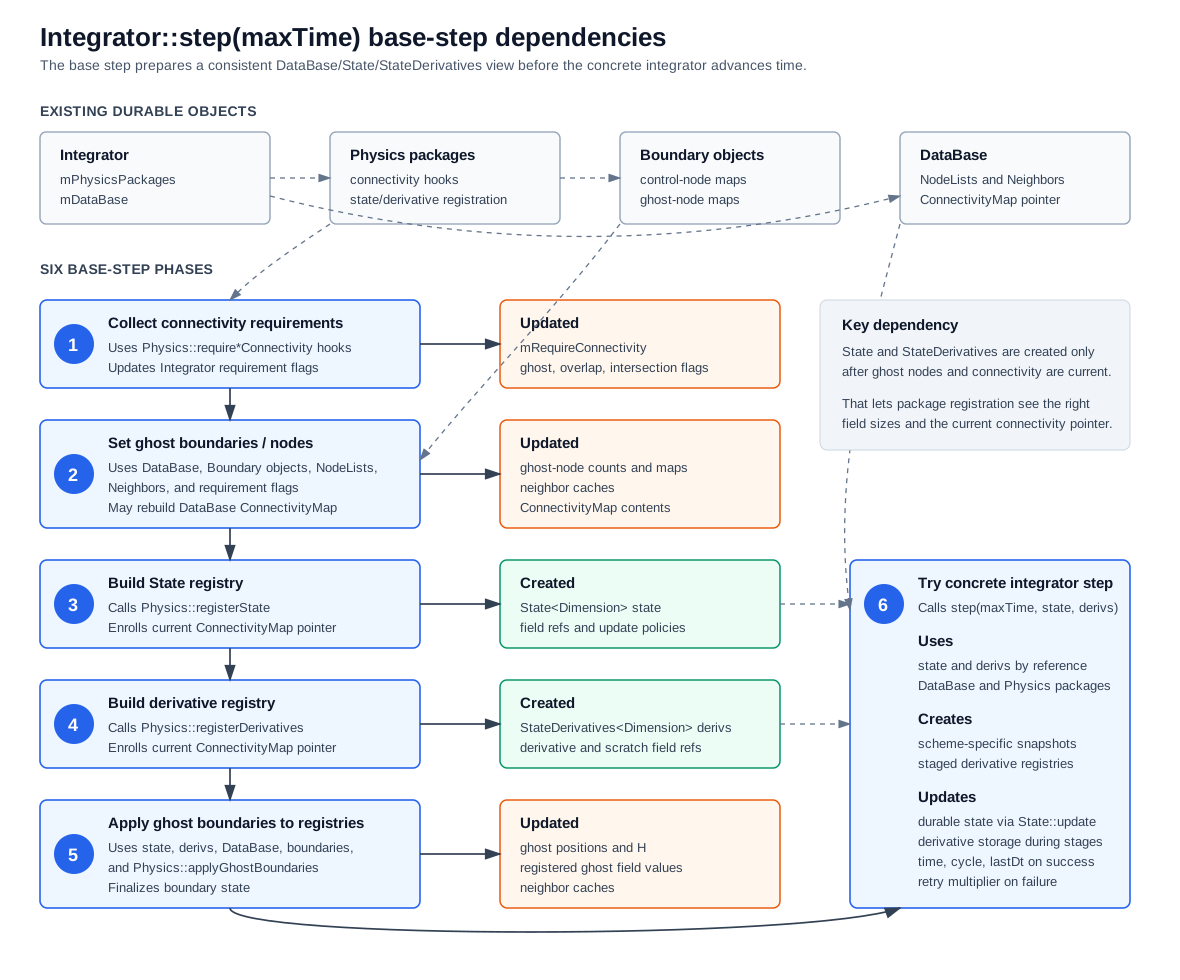
Dependency flow for the six shared phases in
Integrator<Dimension>::step(maxTime).
Existing durable objects
------------------------

Integrator
  |-- mPhysicsPackages --> Physics packages --> Boundary objects
  `-- mDataBase        --> DataBase --> NodeLists, Neighbors, ConnectivityMap


(1) Collect Connectivity Requirements
    uses:    Physics packages
    updates: Integrator requirement flags
             mRequireConnectivity
             mRequireGhostConnectivity
             mRequireOverlapConnectivity
             mRequireIntersectionConnectivity
           |
           v

(2) Set Ghost Boundaries / Nodes
    uses:    DataBase, Boundary objects, NodeLists, Neighbors,
             requirement flags
    updates: NodeList ghost-node counts
             Boundary control-node and ghost-node maps
             Neighbor node caches
             DataBase ConnectivityMap, when required
           |
           v

(3) Build State Registry
    creates: State<Dimension> state
    uses:    DataBase, Physics packages, current ConnectivityMap pointer
    updates: state registry entries and update policies through
             Physics::registerState
           |
           v

(4) Build Derivative Registry
    creates: StateDerivatives<Dimension> derivs
    uses:    DataBase, Physics packages, current ConnectivityMap pointer
    updates: derivative registry entries through
             Physics::registerDerivatives
           |
           v

(5) Apply Ghost Boundaries to New State / Derivatives
    uses:    state, derivs, DataBase, Boundary objects, Physics packages
    updates: ghost positions and H fields
             Neighbor node caches
             registered ghost field values in state and derivs
           |
           v

(6) Try New Integrator Step
    uses:    state, derivs, DataBase, Physics packages
    creates: concrete-integrator temporaries, such as snapshots or
             staged derivative registries
    updates: durable fields through State::update
             derivative storage during staged evaluations
             integrator time, cycle, and lastDt on success
             retry multiplier on failure
Step |
Created |
Used |
Updated |
|---|---|---|---|
Collect connectivity requirements |
None |
|
Integrator requirement flags |
Set ghost boundaries / nodes |
Ghost-node entries and connectivity contents as needed |
|
Ghost counts, boundary control/ghost maps, neighbor caches, and
|
Build state registry |
|
|
State registry entries, field references, and update policies |
Build derivative registry |
|
|
Derivative registry entries and field references |
Apply ghost boundaries to new registries |
Usually none |
|
Ghost positions, ghost |
Try concrete integrator step |
Scheme-specific temporaries |
|
Durable state fields, derivative storage, and integrator bookkeeping |
The derived method receives registries that refer to durable data owned
elsewhere. Any field changes made through state mutate the underlying
NodeList or package-owned fields.
Integrator Base Object
Integrator<Dimension> stores:
a reference to the active
DataBase;the ordered vector of
Physicspackage pointers;time controls:
dtMin,dtMax,dtGrowth,lastDt,dtCheckFrac,currentTime, andcurrentCycle;retry state through
mDtMultiplier;boundary cadence through
updateBoundaryFrequency;connectivity requirement flags collected from physics packages;
ghost culling and domain-decomposition options;
restart registration for integrator time bookkeeping.
Physics packages are appended through appendPhysicsPackage. That method
also inserts any package-declared pre- or post-subpackages, so the integrator’s
package order is the final execution order. The controller may also insert
support packages before the integrator is constructed or before advancement
begins.
The base class exposes common hooks used by concrete integrators:
preStepInitializeCalls
Physics::preStepInitializeon each package once at the beginning of a concrete step.selectDtQueries each package for a
dtvote, keeps the smallest positive vote, applies the retry multiplier, applies the growth limit, clamps to the requested bounds, and optionally reduces to a global MPI minimum.initializeDerivativesClears the database work field, calls
Physics::initializeon each package, and reapplies ghost boundaries if any package requests it.evaluateDerivativesCalls
Physics::evaluateDerivativeson each package.finalizeDerivativesCalls
Physics::finalizeDerivativeson each package after all derivative contributions have been evaluated.postStateUpdateCalls
Physics::postStateUpdateafter state has changed and reapplies ghost boundaries if any package requests it.postStepFinalizeCalls
Physics::finalizeonce at the end of a completed step.setGhostNodes,applyGhostBoundaries, andenforceBoundariesCoordinate boundary-created ghosts, ghost field updates, violation nodes, and package-specific boundary behavior.
The concrete integrator should use these hooks instead of directly iterating over packages unless it is deliberately changing the shared protocol.
Concrete Integrators
All current explicit integrators follow the same high-level loop:
read current time and database;
call
preStepInitialize;select a
dt;initialize, zero, evaluate, and finalize derivatives;
call
state.updateaccording to the method’s time centering;apply and finalize ghost boundaries after state changes;
run post-update and finalization hooks;
enforce boundaries;
advance
currentTime,currentCycle, andlastDton success.
The methods differ in how many derivative evaluations they perform and what state snapshot they restore before the final update.
ForwardEuler
ForwardEuler is the simplest method:
evaluate derivatives at the beginning state;
call
state.update(derivs, dt, t, dt);apply boundaries and post-update hooks;
finalize the step.
It is useful as a reference for the minimal integrator contract because there is no trial midpoint or corrector state.
SynchronousRK2
SynchronousRK2 performs a midpoint Runge-Kutta update:
evaluate beginning derivatives;
copy
statetostate0and callstate0.copyState;trial-update the live state by
0.5 * dt;evaluate midpoint derivatives;
optionally reject the step if the new
dtvote is too small;restore from
state0;update by the full
dtusing midpoint derivatives.
The important implementation detail is the snapshot. A normal State copy is
reference-based. copyState is required when an integrator needs an owned
snapshot for trial-state restore.
CheapSynchronousRK2
CheapSynchronousRK2 is a midpoint-style method optimized to avoid a full
extra end-of-step derivative evaluation. It sets state.timeAdvanceOnly(true)
for the midpoint predictor so replacement-style policies are forced through
updateAsIncrement where possible. After midpoint derivative evaluation it
restores the original state, disables timeAdvanceOnly, and advances by the
full dt.
This method is the main reason UpdatePolicyBase has both update and
updateAsIncrement. Some policies can replace state when derivatives are
fresh and properly centered, but must degrade to incremental time advancement
when derivative information is being reused as a predictor.
PredictorCorrector
PredictorCorrector stores both the beginning state and beginning
derivatives:
evaluate beginning derivatives;
copy
state0andderivs0withcopyState;predictor-update to the end of the step;
evaluate end-of-step derivatives;
restore from
state0;apply half of
derivs0and half of the end derivatives.
The method uses copyGhostState before restoring the beginning state so ghost
position and H state can be carried across the corrector staging.
Verlet
Verlet is specialized around position and velocity time centering:
copy beginning positions;
evaluate beginning derivatives;
predict a midpoint state by a half-step update;
copy the midpoint state;
compute end positions from beginning positions plus midpoint velocity;
predict an endpoint state and override positions with the centered positions;
evaluate endpoint derivatives;
restore the midpoint state;
correct the final state by a half-step using endpoint derivatives and keep the centered endpoint positions.
This method shows that concrete integrators may manipulate selected fields directly when a numerical scheme requires it. The exception is narrow: field-specific physics semantics still belong in update policies.
Implicit Integrators
Implicit integration adds two concepts to the same object model:
some state policies are marked as independent unknowns;
the integrator solves for those unknowns such that a residual equation is satisfied.
ImplicitIntegrator inherits from Integrator and overrides two major
behaviors:
step(maxTime)Builds
StateandStateDerivativesand retries the concrete implicit step by adjustingmDtMultiplier. A successful implicit step can grow the multiplier up tomMaxAllowedDtMultiplier; a failed solve reduces it.selectDtQueries both
Physics::dtandPhysics::dtImplicit. The explicit vote remains the baseline, while the implicit vote limits the multiplier so the chosen step does not exceed package-declared implicit bounds.
computeResiduals asks every package for maxResidual and returns the
global maximum. Packages that do not support implicit advancement should leave
the default maxResidual behavior in place, which raises an error.
BackwardEuler implements the current implicit concrete method. It starts
with explicit RK2-like advancement for early cycles or when the multiplier is
below one. Once enough history exists and the multiplier is suitable, it:
evaluates beginning derivatives and copies
state0andderivs0;creates an initial end-of-step guess with a forward-Euler and Crank-Nicolson-style predictor;
serializes independent state into a vector of doubles;
builds a
KINSOLsolver and anImplicitIntegrationVectorOperator;solves for independent state;
restores
state0and applies the final update using solved derivatives;stores serialized state history for future predictions.
ImplicitIntegrationVectorOperator is the adapter between Spheral state and
the nonlinear solver. Given a candidate vector x it:
deserializes
xinto independent fields;calls
state.update(..., dependentOnly=true)so dependent state follows;applies ghost boundaries and post-update hooks;
evaluates derivatives at the candidate state;
serializes derivative values for independent fields;
computes the residual
x - x0 - dt * ((1 - beta) * derivs0 + beta * derivs(x))
The implicit machinery therefore reuses the same policies, derivative registries, and package hooks as explicit integration. The extra requirement is that independent policies must know how to serialize their state and derivatives.
StateBase: Registry and Storage
StateBase<Dimension> is the common implementation behind State and
StateDerivatives. It is a typed registry keyed by strings.
The key data members are:
mStoragestd::map<KeyType, std::any>. Entries usually holdstd::reference_wrapper<T>so the registry points at existing state rather than owning it.mCachestd::list<std::any>used when the registry must own something, such as cloned fields fromcopyStateor shared-pointer enrolled fields.mNodeListPtrsSet of node lists represented by registered fields.
mConnectivityMapPtrShared pointer to the current
ConnectivityMap.mMeshPtrShared pointer to an enrolled mesh, with a default mesh allocated by the default constructor.
Field keys follow one convention:
fieldName|nodeListName
StateBase::key(field) builds that full key from the field name and its node
list name. StateBase::key(fieldList) uses the first field’s name plus the
update-policy wildcard:
fieldName|*
The wildcard key is a policy key, not a stored field for every node list.
The map ordering is used deliberately. fields(name) searches from the
prefix name + "|" and appends every registered field whose full key starts
with that prefix. This provides an efficient way to reconstruct a FieldList
view over per-node-list fields registered under the same field name.
Reference Versus Copy Semantics
The most common StateBase entries are references:
mStorage[key] = std::ref(field_or_object)
That means a plain copy of State or StateDerivatives copies references.
The copied registry still points at the same durable fields as the original.
There are three different copy-like operations:
- Plain copy constructor or assignment
Copies the registry by reference. This is cheap and is useful when a function wants another handle to the same underlying fields.
assign(rhs)Copies values from the registered objects in
rhsinto the corresponding registered objects inthis. It uses anAnyVisitorover supported field, scalar, vector, tensor, pairwise-field, and vector types. Connectivity is copied by shared pointer; meshes are copied by value.copyState()Replaces referenced entries with owned clones stored in
mCache. Field entries are cloned throughFieldBase::clone; supported non-field entries are copied into shared objects stored in the cache. After this call the registry is an owned snapshot suitable for trial-state restore.
Concrete integrators rely on this distinction. For example:
State state0(state);   // reference copy
state0.copyState();    // now state0 owns a snapshot
...
state.assign(state0);  // restore values into durable fields
For new integrator work, missing copyState after a trial snapshot is a
common source of subtle bugs: the snapshot will track the live fields instead
of preserving the beginning-of-step values.
State Construction
Constructing State is not just allocation. It executes package registration:
State(dataBase, packageBegin, packageEnd):
    for each package:
        package->registerState(dataBase, *this)
    if dataBase.connectivityMapPtr():
        enrollConnectivityMap(dataBase.connectivityMapPtr())
StateDerivatives has the analogous construction path:
StateDerivatives(dataBase, packageBegin, packageEnd):
    for each package:
        package->registerDerivatives(dataBase, *this)
    if dataBase.connectivityMapPtr():
        enrollConnectivityMap(dataBase.connectivityMapPtr())
Packages are expected to keep durable storage in node lists or package member fields, then register references to that storage each step. The constructors are called every step, so registration should resize existing package fields when necessary rather than creating new long-lived objects each time.
Representative package registration from SPH/CRKSPH follows this pattern:
resize package-owned field lists such as pressure, sound speed, entropy, and derivative scratch fields to match the current database;
enroll node-list-owned mass, position, velocity, density,
H, and thermal energy fields;enroll package-owned derived fields such as pressure and sound speed;
attach update policies to fields that should be recomputed or advanced by
State::update;enroll derivative fields with names that match the update-policy lookup convention.
State and Derivative Responsibilities
State and StateDerivatives use the same registry mechanics but represent
different phases of the calculation.
StateCarries state fields and policy metadata. Many entries reference durable fields on
NodeListobjects or package-owned fields.State::updateis allowed to mutate those fields.StateDerivativesCarries derivative, replacement, scratch, and pairwise data. Integrators usually call
derivs.Zero()before derivative evaluation. Packages then fill these entries inevaluateDerivativesand finish them infinalizeDerivatives.
Derivative zeroing is type-driven. StateDerivatives::Zero builds an
AnyVisitor that knows how to zero registered fields, primitive dimension
types, vectors of dimension types, sets, and supported PairwiseField
entries. Some registered objects, such as reproducing kernels, intentionally
have no zero action.
Update Policy Model
UpdatePolicyBase is the field update interface. A policy defines:
update(key, state, derivs, multiplier, t, dt);optional
updateAsIncrementbehavior for predictor paths;dependency field names;
whether the policy should be applied per field when registered with a
FieldList;whether the policy represents independent state for implicit integration;
serialization hooks for implicit integration.
State stores policies separately from the field registry:
mPolicyMap[fieldName][fullFieldKey] = policy
The outer key is the unmangled field name. The inner key is either a full
fieldName|nodeListName key or a wildcard fieldName|* key. This layout
lets State::update reason about dependencies at the field-name level while
still applying policies to specific node-list fields.
When a FieldList is enrolled with a policy, State checks
policy->clonePerField():
trueEnroll each field in the list and attach the policy under each full field key.
FieldUpdatePolicyreturnstrueand is the base for policies that operate on oneFieldat a time.falseEnroll the fields for lookup, but attach one policy under the wildcard
fieldName|*key. The policy is responsible for operating on the field list as a whole.
Update Dependency Resolution
State::update applies policies in dependency order. Its algorithm is:
collect every registered policy into a remaining-work map;
maintain a list of field names still waiting to be updated;
for each remaining policy, check whether all declared dependencies are no longer in the waiting list;
for a field with both wildcard and node-list-specific policies, fire the wildcard policy first;
call
updateorupdateAsIncrementdepending onstate.timeAdvanceOnly();remove completed keys from the remaining-work map;
repeat until all policies have fired.
If an iteration makes no progress, the dependency graph is circular and
State::update raises an error that lists the remaining fields and their
declared dependencies.
The dependency names are field names, not full field|nodeList keys. For
example, a velocity policy can depend on position and
specific thermal energy. It does not name every node list separately.
The dependentOnly flag is used by implicit integration. When
dependentOnly is true, independent policies are called with a zero
multiplier and zero dt while dependent policies update normally. This lets
the nonlinear solver unpack candidate independent variables and then recompute
state that depends on them.
Standard Policy Families
The core policy classes cover common update patterns.
IncrementStateUpdates a field by adding derivative fields:
f(i) += multiplier * df(i)
For a state key
fieldName|nodeListNameit searches derivative keys on the same node list whose field name starts with"delta " + fieldName. IfwildCardDerivsis false, exactly one matching derivative field must be present. If true, all matching derivative fields are accumulated. Velocity is a common wildcard use case because several packages can contribute acceleration fields whose names start withdelta velocity.IncrementBoundedStateSame as
IncrementStatebut clamps the result between a minimum and maximum value. Density updates commonly use node-list-specific bounds.PureReplaceStateReplaces state from a derivative registry field named
"new " + key. For a full state keymass density|nodesthe replacement key isnew mass density|nodes.ReplaceStateUses
PureReplaceStatefor normalupdate. ItsupdateAsIncrementfalls back toIncrementStateso predictor schemes can advance when replacement data is not time centered.PureReplaceBoundedStateandReplaceBoundedStateReplacement variants that enforce bounds.
ReplaceBoundedStatealso has an increment fallback throughupdateAsIncrement.MaxReplaceStateReplaces a field with the maximum of the current state and the replacement field.
- Package-specific policies
Policies such as
PressurePolicy,SoundSpeedPolicy,SpecificThermalEnergyPolicy,EntropyPolicy,DeviatoricStressPolicy, damage policies, and strength policies encode derived-state or material-model behavior that cannot be represented as a simple increment or replacement.
Implicit integration currently treats IncrementState as independent state
by default. Replacement and derived-state policies generally report dependent
state. Field policies also provide serialization helpers for fixed-size data
types so implicit solvers can pack fields into std::vector<double>.
Derivative Naming Contract
Policies and derivative registration communicate by string convention. The important prefixes are:
"delta "Derivative/increment data for
IncrementStateand related policies."new "Replacement data for
PureReplaceStateand replacement policies.
Field names can include additional qualifiers after the prefix. For example,
HydroFieldNames::hydroAcceleration is "delta velocity hydro". A
velocity IncrementState policy with wildcard derivatives accepts it because
the field name starts with "delta velocity".
This convention is flexible, but it is not type checked. When adding a package, verify that:
every increment policy has matching derivative fields on the same node list;
non-wildcard increment policies have exactly one match;
replacement policies register the expected
"new " + keyfields;derivative field value types match the state field value types;
dependencies use field names that are actually policy-controlled.
Physics Package Contract
The integrator sees every equation package through Physics<Dimension>.
Required methods are:
registerStateEnroll fields and policies in
State.registerDerivativesEnroll derivative and scratch data in
StateDerivatives.evaluateDerivativesFill derivative fields from the current state, database, and connectivity.
dtVote on the explicit time step.
labelProvide a package name for diagnostics and restart labels.
Optional hooks let packages participate in startup, derivative initialization, derivative finalization, post-update work, step finalization, boundaries, connectivity requirements, Voronoi/RK requirements, visualization state, and implicit integration.
The package contract is deliberately broad because package types vary widely. The important implementation discipline is narrower:
state registration should describe what the package owns or needs;
derivative evaluation should fill derivative fields, not directly advance durable state;
update policies should encode how durable state changes;
post-update/finalize hooks should repair or recompute package-specific derived data that truly belongs after an update stage.
Registration Example: SPH-Like Packages
Hydro packages illustrate the full model.
SPHBase::initializeProblemStartupCreates package-owned field lists for pressure, sound speed, omega grad-h, entropy, mass-density sums, XSPH data, derivative fields, velocity gradients, and correction tensors.
SPHBase::registerStateEnrolls mass without a policy, density with an
IncrementBoundedStatepolicy, position with anIncrementStatepolicy, velocity with a wildcardIncrementStatepolicy, time-step mask without a policy, pressure withPressurePolicy, sound speed withSoundSpeedPolicy, and omega grad-h without a normal update policy.SPH::registerStateAdds the specific thermal energy policy. Depending on runtime options it uses compatible-energy, total-energy-derived, or plain increment behavior.
SPHBase::registerDerivativesResizes and enrolls derivative storage such as mass-density corrections, mass-density replacement sums, XSPH delta velocity, acceleration,
delta mass density,delta specific thermal energy, and velocity gradients.SPH::registerDerivativesAdds pair acceleration storage when compatible energy evolution needs it.
The concrete integrator does not know any of this. It only calls package hooks
and then state.update. The package registration and policy graph determine
the actual durable field changes.
Boundary and Connectivity Interaction
The integrator also owns the timing of boundary and connectivity updates.
At the beginning of the public base step it asks packages for connectivity
requirements. Those requirements determine how setGhostNodes behaves:
whether to build any
ConnectivityMap;whether ghost connectivity is included;
whether overlap connectivity requires temporarily enlarged kernel extents;
whether intersection connectivity is computed.
After ghost nodes are created and neighbor structures are current,
DataBase::updateConnectivityMap builds the shared map. New State and
StateDerivatives objects enroll the database connectivity pointer during
construction. Physics packages can then access connectivity through the
database or through the enrolled state.
During concrete time integration, applyGhostBoundaries is called after
state changes and sometimes before derivative evaluation. It updates ghost node
positions and H fields through boundary objects, refreshes neighbor data,
delegates package field ghost updates to Physics::applyGhostBoundaries, and
finalizes boundaries.
enforceBoundaries is distinct. It finds internal nodes that violate
boundary constraints and asks packages to enforce boundary behavior on their
fields. Concrete integrators normally call it after state updates or before
final completion.
Developer Extension Guidelines
When adding a concrete integrator:
implement
step(maxTime, state, derivs)and reuse base hooks;snapshot trial states with
copyStatebefore mutating live fields;restore through
state.assign(snapshot)on rejection or before final updates;update
currentTimeconsistently during staged derivative evaluations;apply ghost boundaries after every staged state mutation that affects fields used by subsequent derivative evaluation;
call
postStateUpdateafter staged updates andpostStepFinalizeonce for a completed step;only manipulate individual fields directly when the numerical method itself requires it.
When adding a physics package:
allocate durable package fields in startup or as package members;
resize package-owned field lists during registration to match the database;
enroll state fields with policies that describe update semantics;
enroll derivative fields with names that match policy lookup conventions;
declare connectivity, Voronoi, and RK requirements through
Physicshooks;keep direct durable-state mutation out of
evaluateDerivativesunless the hook is explicitly meant to maintain package scratch state.
When adding an update policy:
declare dependencies by field name;
decide whether the policy operates per field or as one wildcard field-list policy;
implement
updateAsIncrementif predictor methods need an incremental fallback;report
independentcorrectly for implicit integration;implement serialization for fixed-size field data if the policy participates in implicit solves;
make derivative key conventions explicit in the policy implementation.
Common Failure Modes
- Reference snapshot accidentally aliases live state
A copied
StatewithoutcopyStatestill references live fields. Trial updates will change the supposed snapshot.- Derivative field names do not match policies
IncrementStateand replacement policies find derivatives by string convention. Mismatched prefixes or node-list names fail at update time.- Wildcard derivative setting is wrong
If several derivative fields match and
wildCardDerivsis false, update fails. If wildcard mode is true when it should not be, independent contributions can be unintentionally accumulated.- Dependency graph is circular
State::updatedetects this only when no remaining policy can fire. The error message lists remaining state and dependencies.- Boundary updates are skipped between staged evaluations
Derivative evaluations can see stale ghost state if an integrator mutates state and then evaluates derivatives without applying/finalizing boundaries.
- Package storage is allocated as transient state
Stateis rebuilt every step. Durable fields should live on node lists or package members and be registered by reference.- Implicit policy classification is wrong
Marking derived state as independent makes the nonlinear solve larger and can make residual packing inconsistent. Marking evolved state as dependent keeps it out of the solve.
Design Boundaries to Preserve
The integrator/state model works because responsibilities stay separated:
Integratorowns shared orchestration and retries;concrete integrators own time-centering order;
Physicspackages own equations, package storage, derivative fills, and requirements;Stateowns update ordering;UpdatePolicyBasedescendants own field update semantics;StateBaseowns type-erased registry mechanics;DataBaseowns node-list aggregation and connectivity lifetime;boundaries own ghost and violation-node mappings.
Device-facing value/view storage, managed view pointer dispatch, RAJA/CHAI execution patterns, and connectivity internals are covered in dedicated documents: Value/View and Device Execution Model, Current RAJA-Captured Object Families, RAJA/CHAI Execution Patterns, Connectivity Data Structures, and Neighbor Family and Usage.